Tally's Beer UniverseThe Brewery Archive

The Archive · Beer history, preserved

The Nine Eras

Nine thousand years is the figure everyone repeats. The evidence supports about five. These boards follow what can actually be sourced — from the first ration tablets to the breweries that started the craft revival and were bought or closed by it.

Watch · Latest from Tally's

4 Ingredients That Changed the World

9
Eras
9 of 9
Boards placed
2
Style files
c. 3400 BCE
Earliest evidence

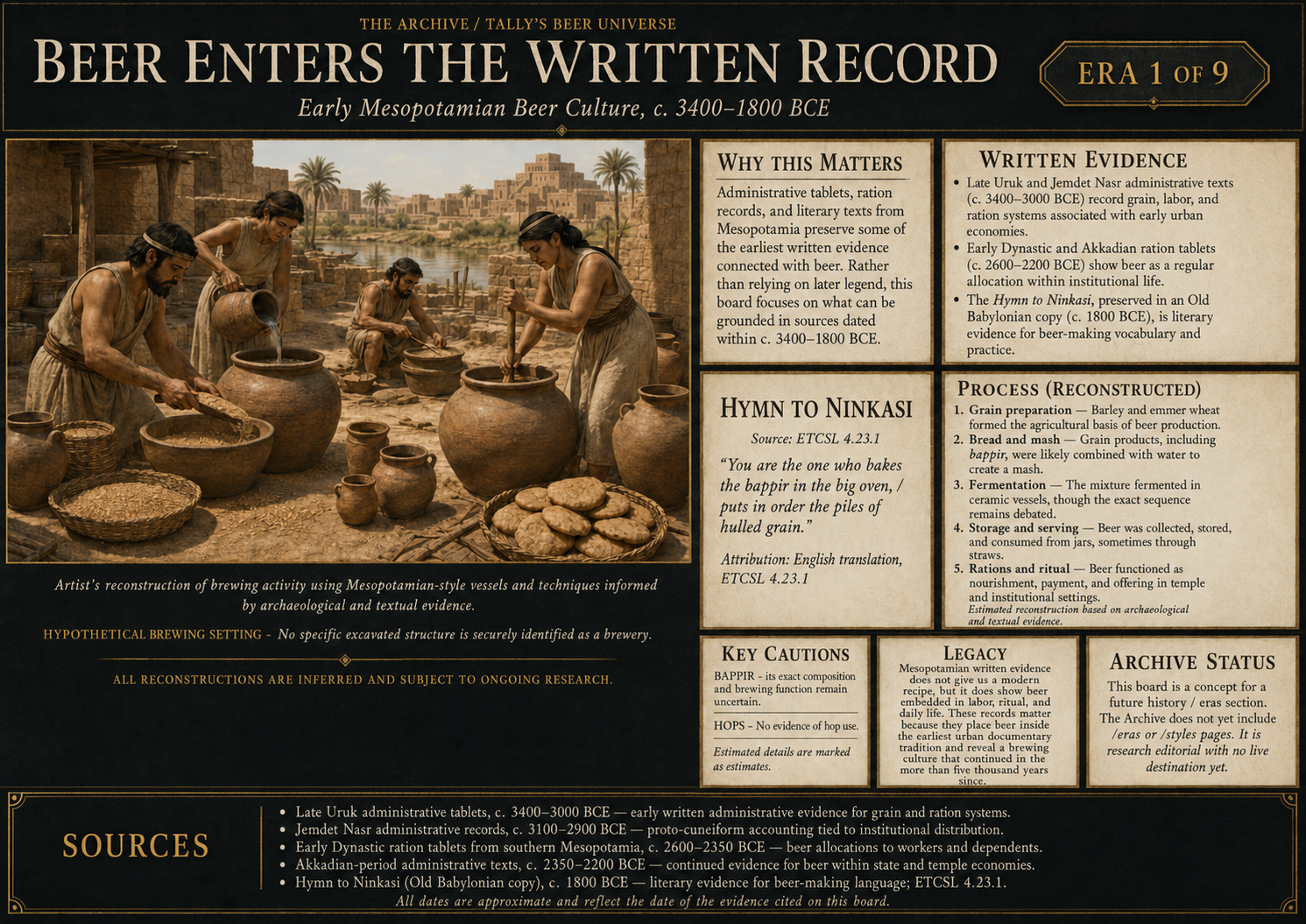
Early Mesopotamia · c. 3400–1800 BCE

Beer Enters the Written Record

Era 1 of 9
Era 1 board — Beer Enters the Written Record, early Mesopotamian beer culture c. 3400–1800 BCE

Administrative tablets, ration records and literary texts preserve some of the earliest written evidence connected with beer.

No specific excavated structure is securely identified as a brewery. Everything here is inferred from what people wrote down about it.

Read the full board — built as a page, not a picture

Sources on the board

  • Late Uruk administrative tablets, c. 3400–3000 BCE
  • Jemdet Nasr administrative records, c. 3100–2900 BCE
  • Early Dynastic ration tablets, c. 2600–2350 BCE
  • Hymn to Ninkasi (Old Babylonian copy), c. 1800 BCE — ETCSL 4.23.1

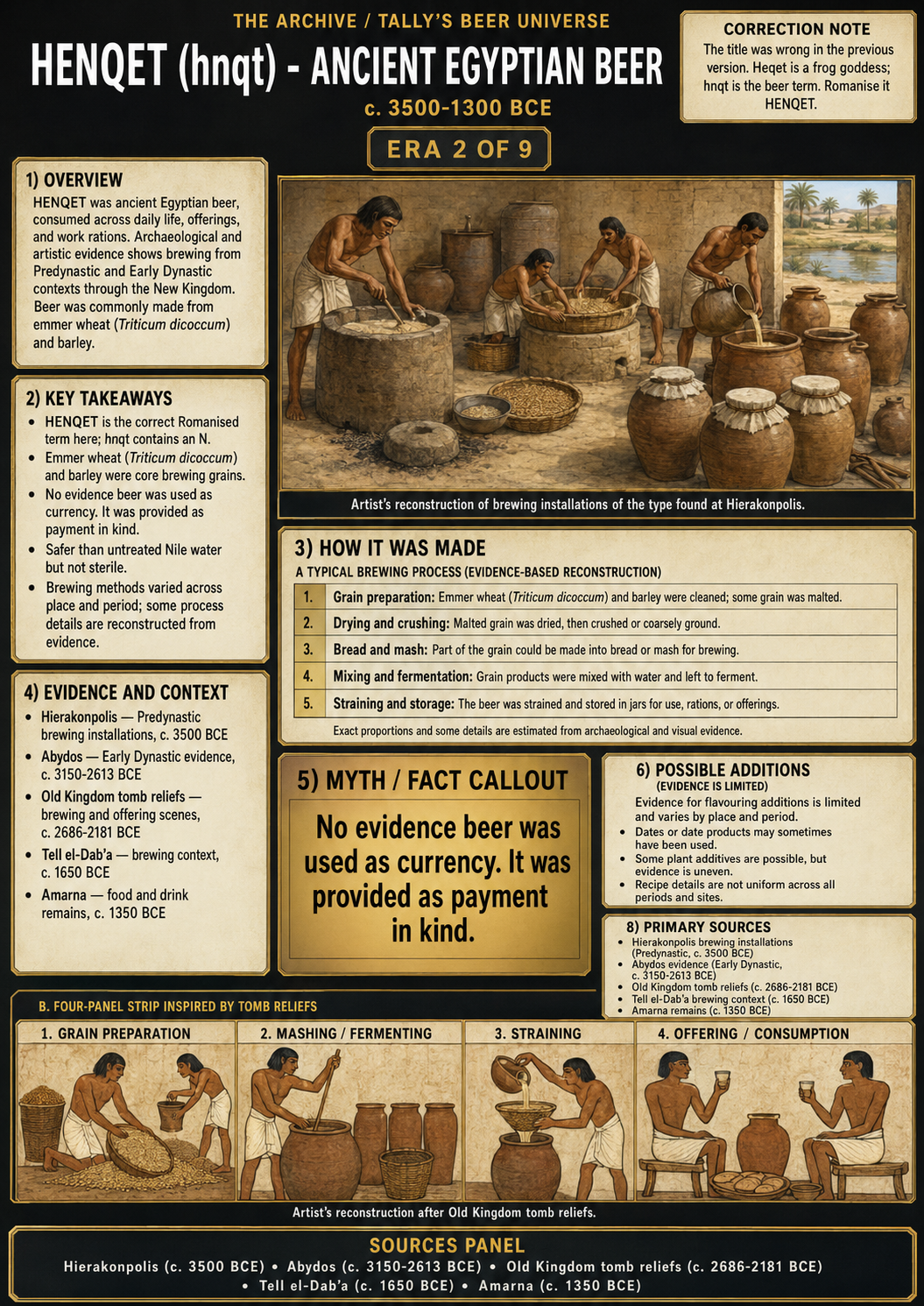
Egypt · c. 3500–1300 BCE

Henqet — Ancient Egyptian Beer

Era 2 of 9
Era 2 board — Henqet, ancient Egyptian beer, c. 3500–1300 BCE

Beer as daily nourishment, temple offering and part of workers' rations, from Predynastic contexts through the New Kingdom.

There is no evidence beer was used as currency. It was provided as payment in kind — a distinction almost every popular account gets wrong.

Sources on the board

  • Hierakonpolis brewing installations, Predynastic, c. 3500 BCE
  • Abydos evidence, Early Dynastic, c. 3150–2613 BCE
  • Old Kingdom tomb reliefs, c. 2686–2181 BCE
  • Tell el-Dab'a brewing context, c. 1650 BCE
  • Amarna remains, c. 1350 BCE

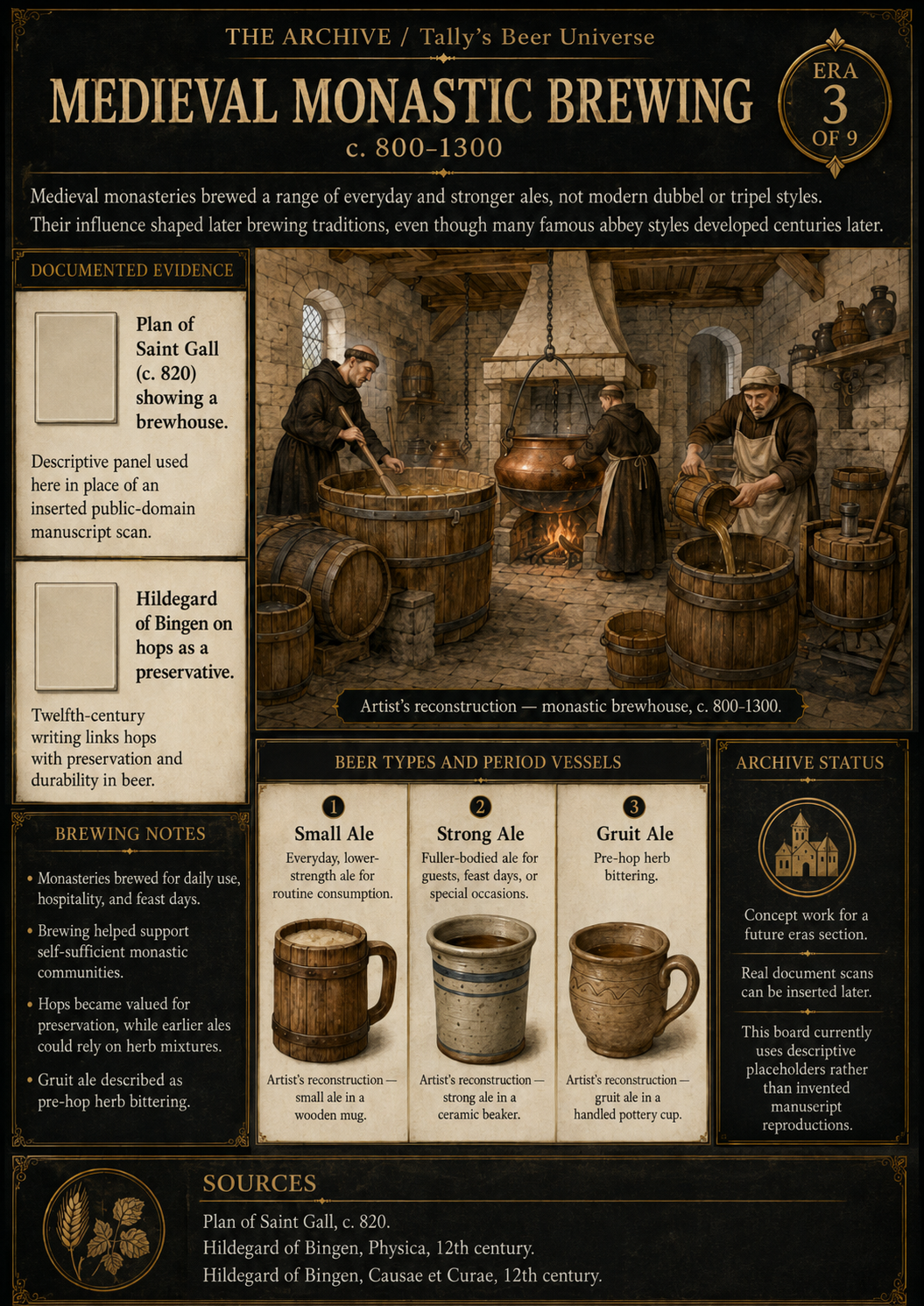
Europe · c. 800–1300

Medieval Monastic Brewing

Era 3 of 9
Era 3 board — Medieval monastic brewing, c. 800–1300

Monasteries brewed a range of everyday and stronger ales — not the modern dubbel and tripel styles their names are now attached to.

The famous abbey styles developed centuries after this period. The influence is real; the continuity is not.

The Monastic Register — 14 breweries, five categories

Sources on the board

  • Plan of Saint Gall, c. 820
  • Hildegard of Bingen, Physica, 12th century
  • Hildegard of Bingen, Causae et Curae, 12th century

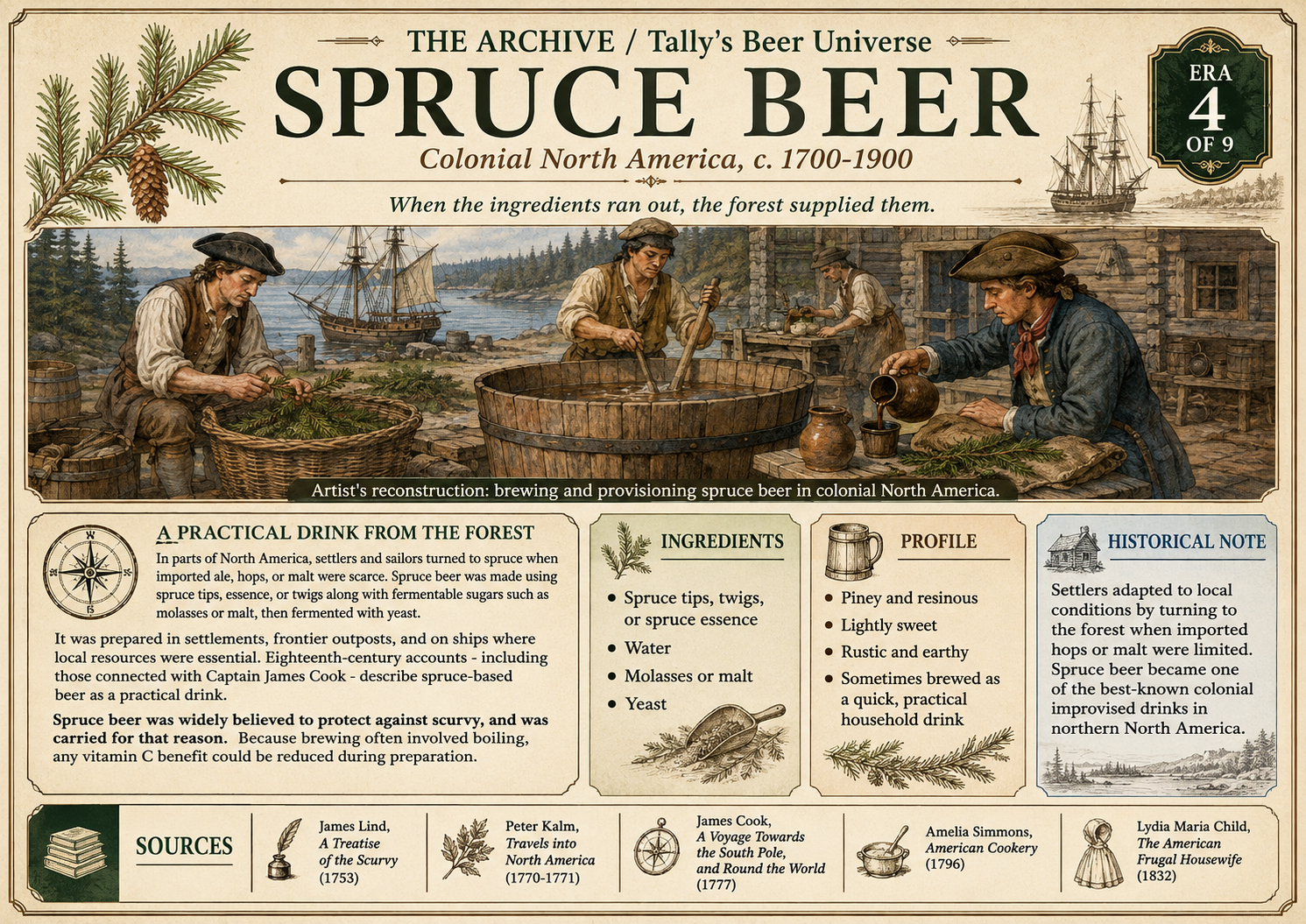
Colonial North America · c. 1700–1900

Spruce Beer

Era 4 of 9
Era 4 board — Spruce beer in colonial North America, c. 1700–1900

When imported ale, hops or malt ran short, settlers and sailors brewed from what the forest supplied.

It was widely believed to prevent scurvy and carried for that reason — but brewing usually involved boiling, which reduces any vitamin C benefit.

Sources on the board

  • James Lind, A Treatise of the Scurvy (1753)
  • Peter Kalm, Travels into North America (1770–1771)
  • James Cook, A Voyage Towards the South Pole (1777)
  • Amelia Simmons, American Cookery (1796)
  • Lydia Maria Child, The American Frugal Housewife (1832)

c. 1800–1900

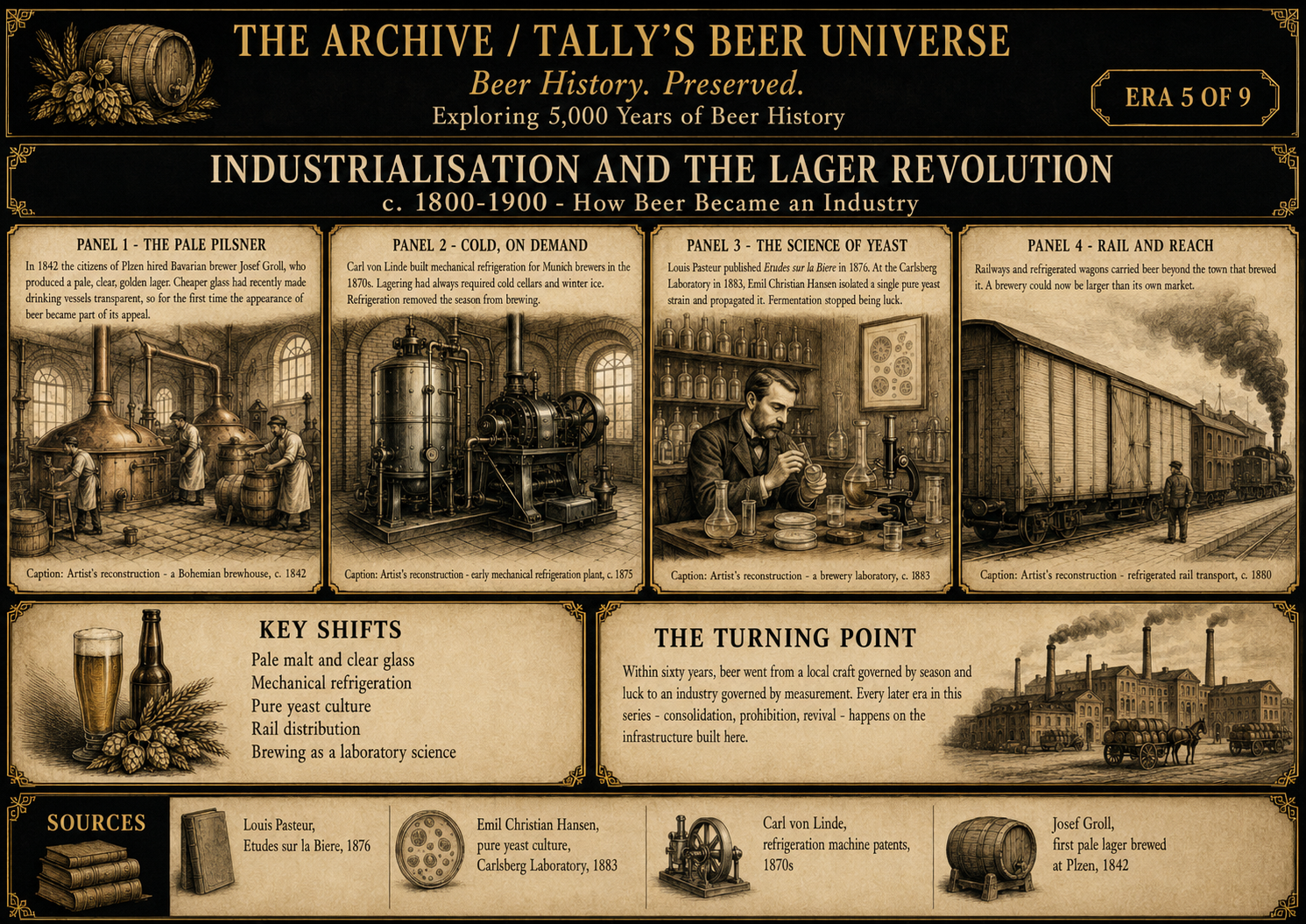
Industrialisation and the Lager Revolution

Era 5 of 9
Era 5 board — Industrialisation and the lager revolution, c. 1800–1900

Refrigeration, pure yeast culture, cheap glass and rail freight turned a local craft into an industry.

In sixty years brewing went from a craft governed by season and luck to one governed by measurement. Every later era runs on the infrastructure built here.

Sources on the board

  • Louis Pasteur, Études sur la Bière, 1876
  • Emil Christian Hansen, pure yeast culture, Carlsberg Laboratory, 1883
  • Carl von Linde, refrigeration machine patents, 1870s
  • Josef Groll, first pale lager brewed at Plzeň, 1842

c. 1800–1980

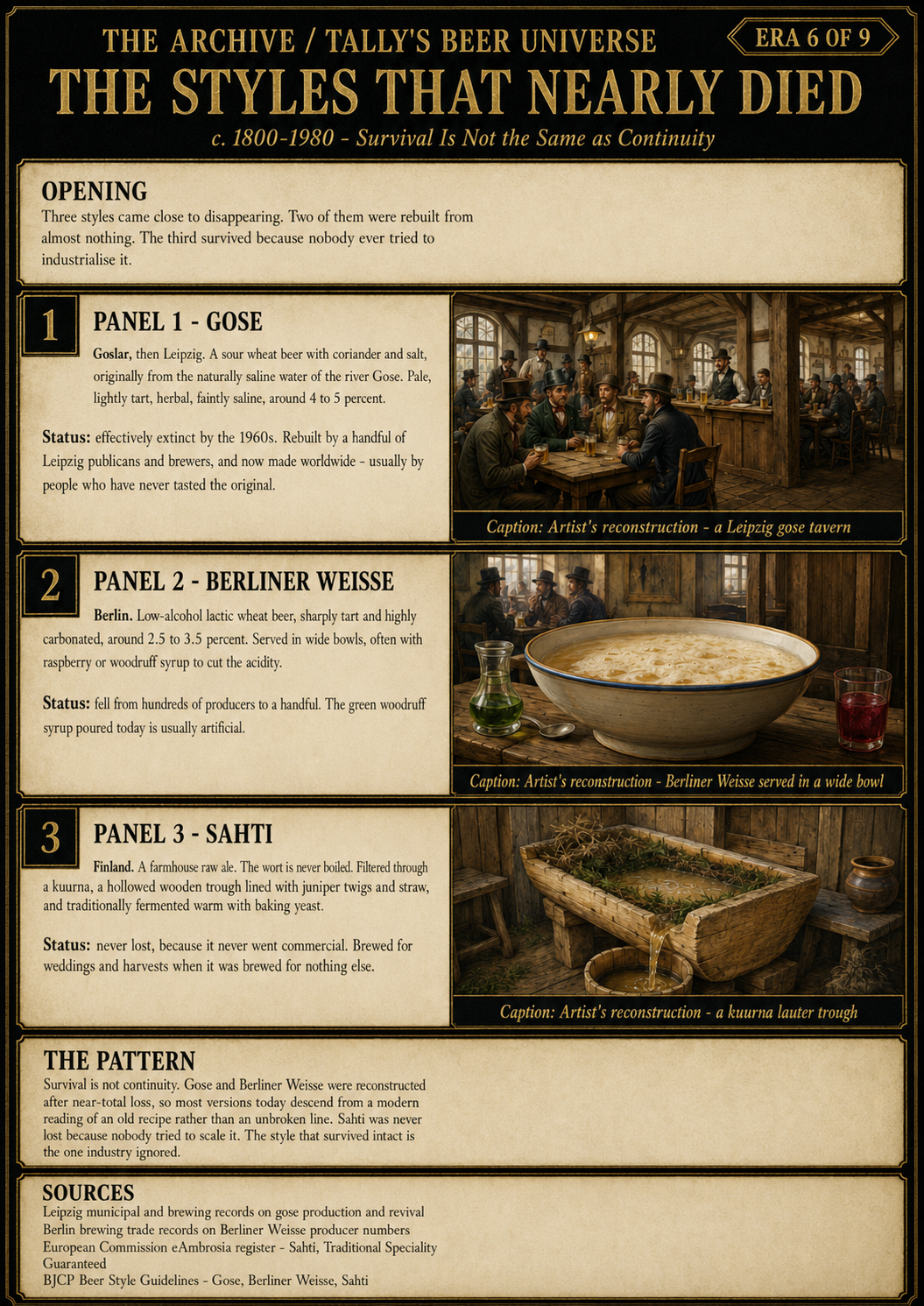
The Styles That Nearly Died

Era 6 of 9
Era 6 board — The styles that nearly died: gose, Berliner Weisse and sahti

Gose, Berliner Weisse and sahti all came close to disappearing — two of them down to almost nothing before anyone thought to rebuild them.

Survival is not continuity. The style that came through intact is the one industry never bothered to scale.

Sources on the board

  • Leipzig municipal and brewing records on gose production and revival
  • Berlin brewing trade records on Berliner Weisse producer numbers
  • European Commission eAmbrosia register — Sahti, Traditional Speciality Guaranteed
  • BJCP Beer Style Guidelines — Gose, Berliner Weisse, Sahti

United States · 1920–1933

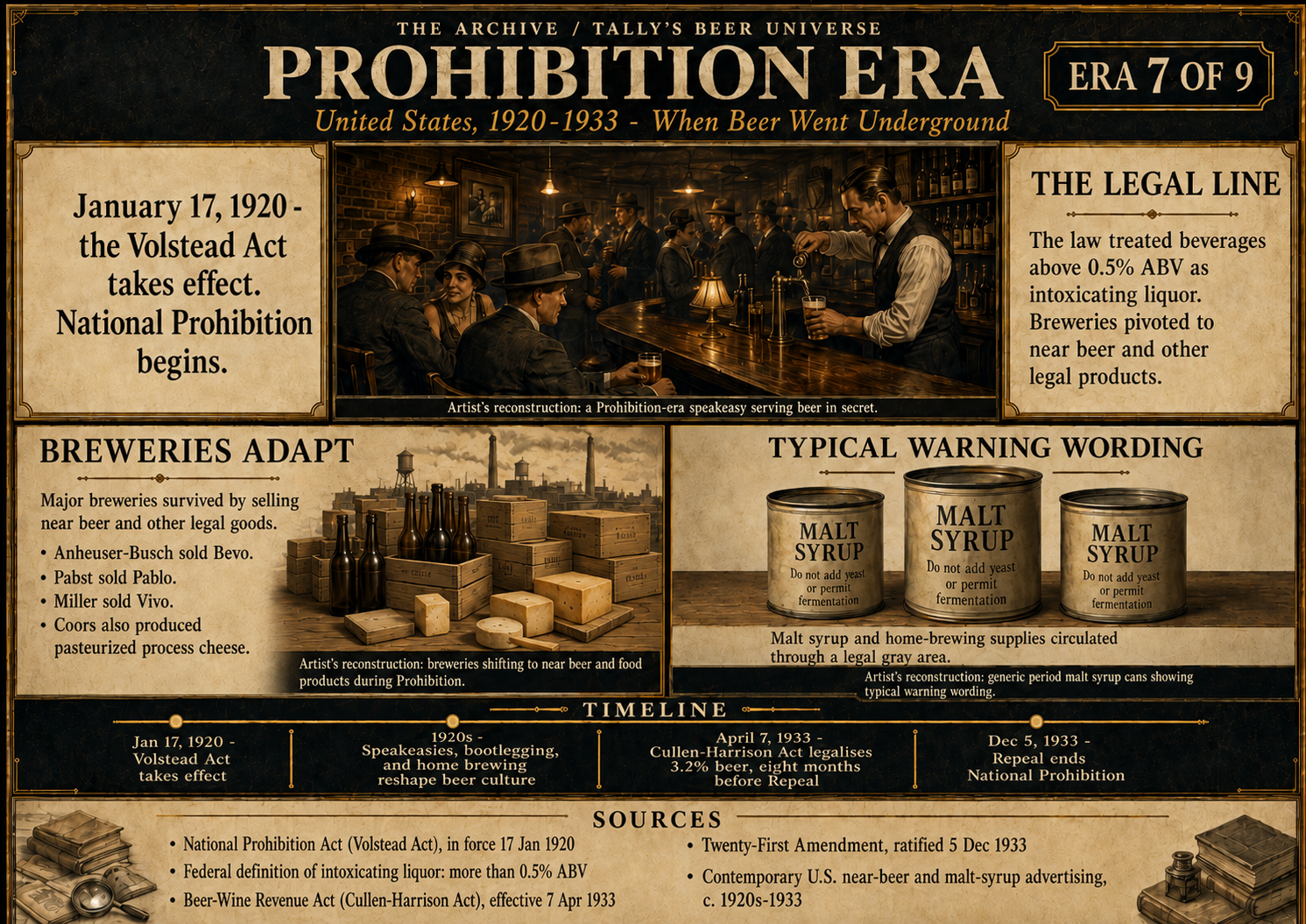
Prohibition

Era 7 of 9
Era 7 board — Prohibition era United States, 1920–1933

Thirteen years in which brewing beer was a crime, and the breweries that survived did it by selling almost anything else.

Breweries sold malt syrup labelled “do not add yeast or permit fermentation,” then watched it sell by the ton. The most successful wink in American business.

The Closed Ledger — breweries that stopped

Sources on the board

  • National Prohibition Act (Volstead Act), in force 17 Jan 1920
  • Federal definition of intoxicating liquor: more than 0.5% ABV
  • Beer-Wine Revenue Act (Cullen–Harrison Act), effective 7 Apr 1933
  • Twenty-First Amendment, ratified 5 Dec 1933

1950s–1970s

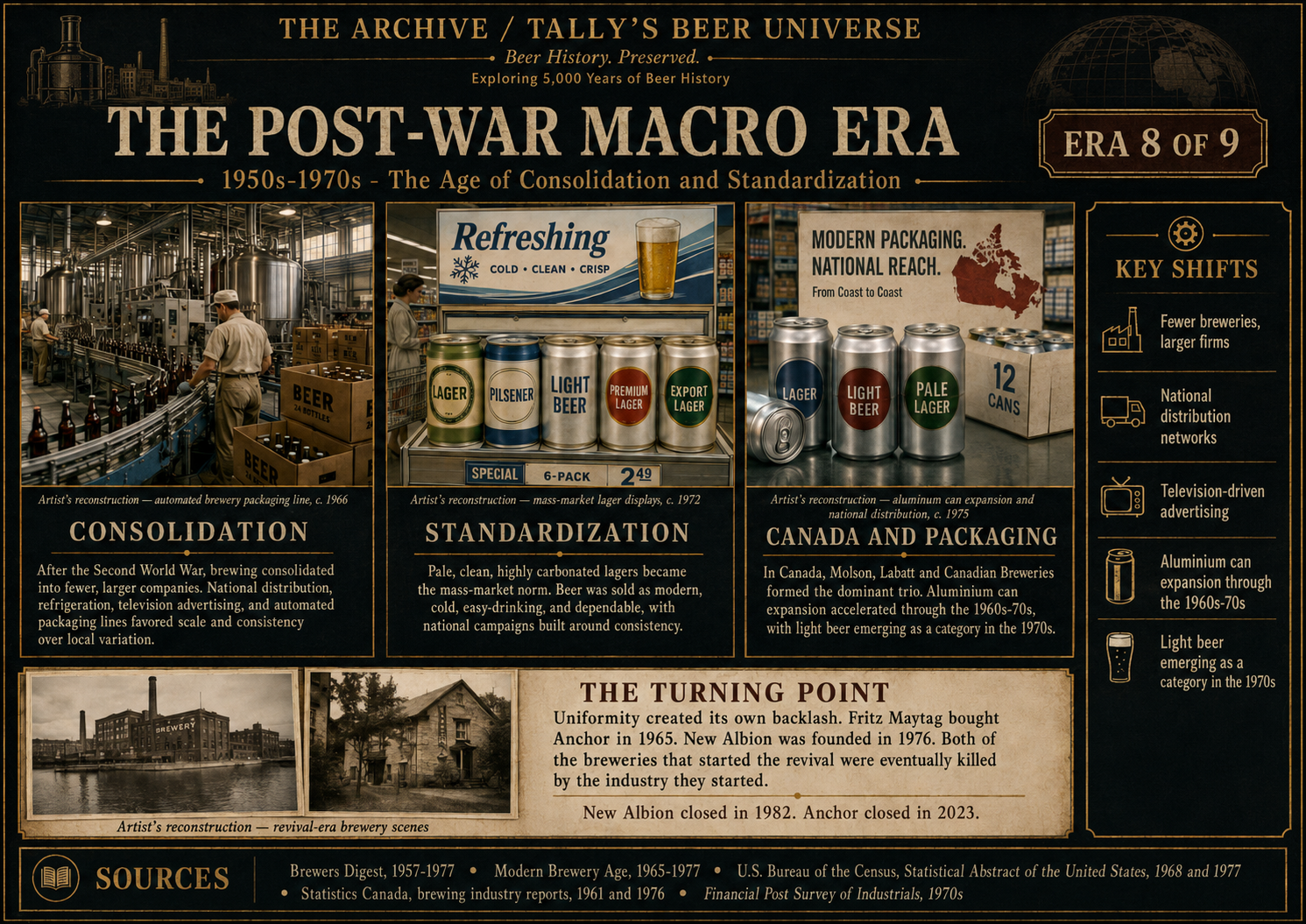
The Post-War Macro Era

Era 8 of 9
Era 8 board — The post-war macro era, 1950s–1970s

Consolidation, national distribution and television advertising favoured scale and consistency over local variation.

Both of the breweries that started the revival were eventually killed by the industry they started. New Albion closed in 1982. Anchor closed in 2023.

The Acquired — every dated change of ownership

Sources on the board

  • Brewers Digest, 1957–1977
  • Modern Brewery Age, 1965–1977
  • U.S. Bureau of the Census, Statistical Abstract of the United States, 1968 and 1977
  • Statistics Canada, brewing industry reports, 1961 and 1976

1965–present

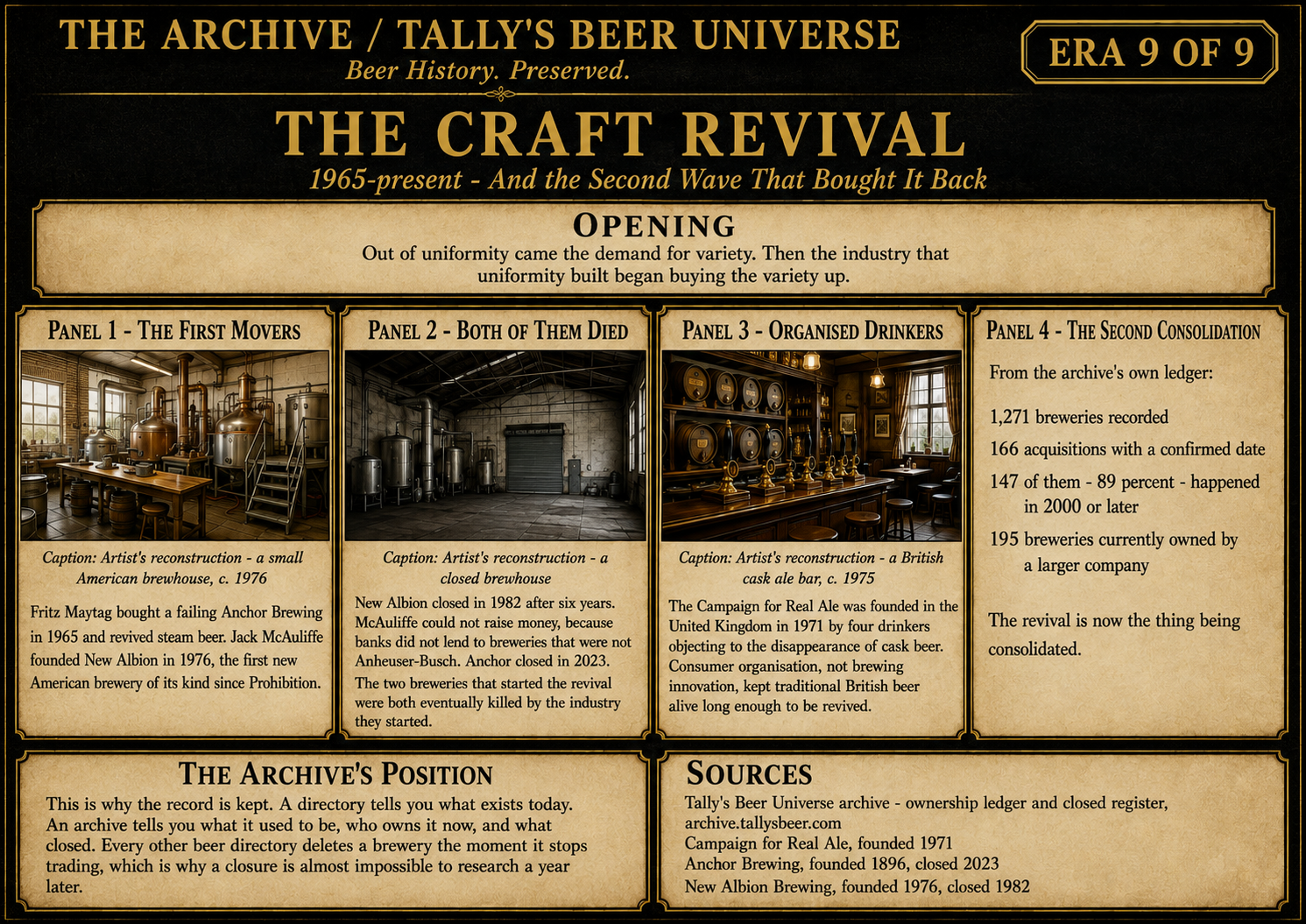
The Craft Revival

Era 9 of 9
Era 9 board — The craft revival, 1965 to present, and the second wave of consolidation

Out of uniformity came the demand for variety — and then the industry uniformity built began buying the variety up.

147 of the archive's 166 dated acquisitions — 89% — happened in 2000 or later. The revival is now the thing being consolidated.

The Acquired — every dated change of ownership

Sources on the board

  • Tally's Beer Universe archive — ownership ledger and closed register
  • Campaign for Real Ale, founded 1971
  • Anchor Brewing, founded 1896, closed 2023
  • New Albion Brewing, founded 1976, closed 1982

Outside the sequence

Style files

Some subjects span too many centuries to sit in one slot. Sahti runs from the 1500s to this afternoon; a Belgian tradition rebuilt in British Columbia covers 1366 to now. Numbering them as eras would break the sequence, so they get their own shelf.

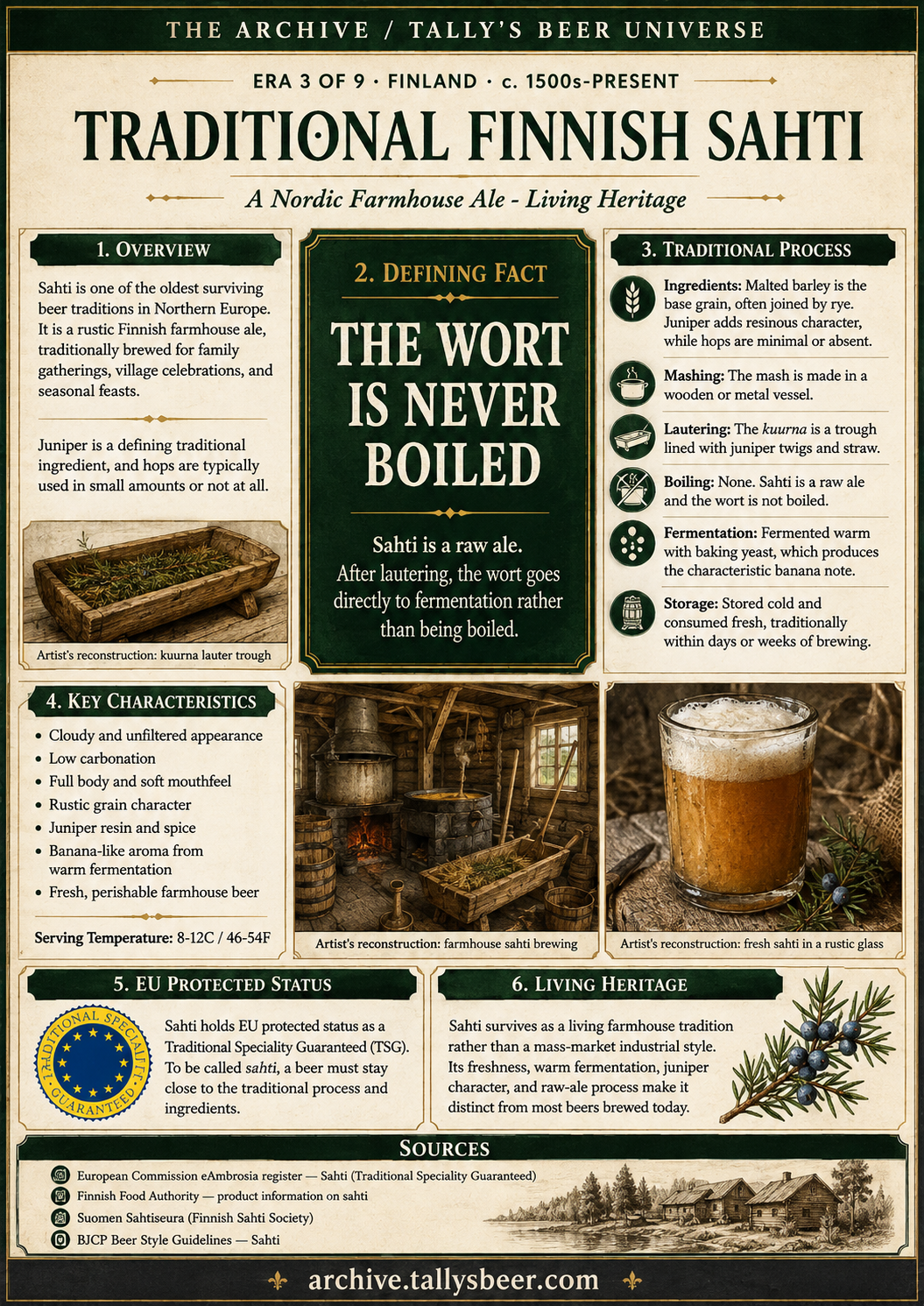
Finland · c. 1500s–present

Traditional Finnish Sahti

Style file board — Traditional Finnish sahti, a Nordic farmhouse ale

A Nordic farmhouse ale that never went industrial, and survived intact because of it.

The wort is never boiled. Sahti is a raw ale — after lautering the wort goes straight to fermentation, which separates it from almost every other beer on earth.

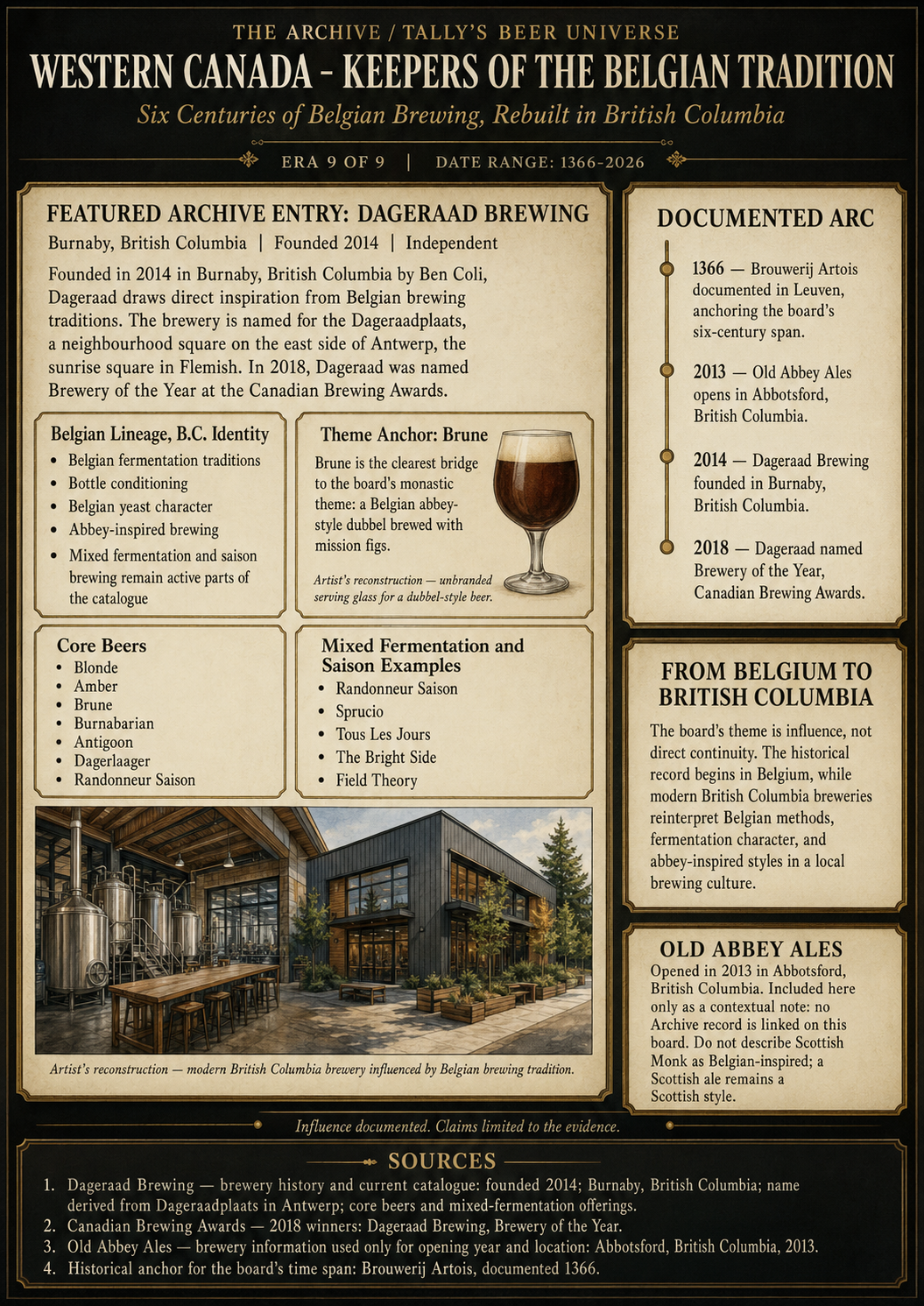
British Columbia · 1366–2026

Western Canada — Keepers of the Belgian Tradition

Style file board — Western Canada, keepers of the Belgian tradition

Six centuries of Belgian brewing, reinterpreted on the other side of the world.

The theme is influence, not continuity. The historical record begins in Belgium; the breweries here opened in 2013 and 2014.

Dageraad Brewing — Burnaby, British Columbia

Every board names its sources on its face. Where an image is a reconstruction rather than a photograph, it says so — and where the archive holds no record for something shown, it says that too. Two eras are still empty. They are listed anyway, because a gap you can see is worth more than one you have to discover.