
Tally's Take · in the glass
Why Stout Bubbles Appear to Fall
Bubbles rise. So why does a settling stout look like it is pouring downward? Because a pint glass is a fluid-dynamics experiment you can drink.
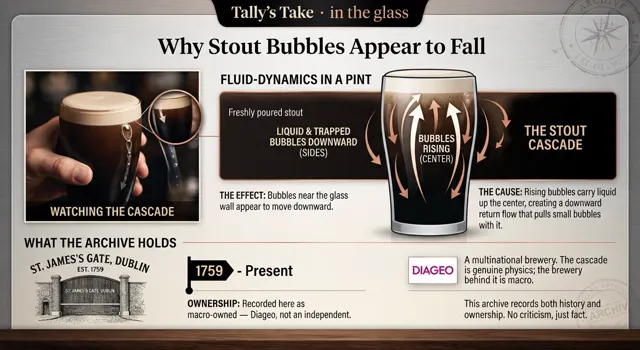
Watch a freshly poured nitrogenated stout closely. Near the outside of the glass, some of the bubbles appear to be moving downward.
That seems impossible. Bubbles rise.
But what you're seeing is a miniature fluid-dynamics experiment. As bubbles rise through the centre of the glass, they help carry liquid upward. That liquid eventually circulates back downward near the sides of the glass. Tiny bubbles caught in that descending flow can be pulled downward with it.
The result is the famous stout cascade.
So the settling effect isn't just presentation. It is physics happening in real time inside your pint. A glass of stout becomes a tiny laboratory containing gas, liquid, gravity and circulation. Beer science hiding in plain sight.
That's Tally's Take.
What the archive holds
St. James's Gate has brewed in Dublin since 1759 and is recorded here as macro-owned — Diageo, not an independent.
That is not a criticism, it is a fact worth having attached to the pint. The cascade is genuine physics; the brewery behind it is a multinational, and this archive says both.